
 Deca
Deca
Back to Legal Webpage
How to obtain Succession Certificate / Legal Heir Certificate / Letters of Administration in India

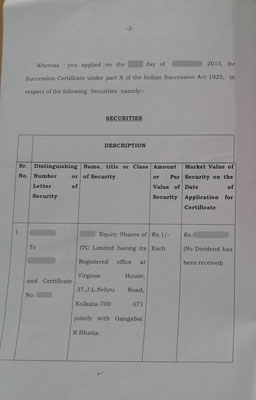


Documents required for Succession Certificate
- Death certificate copy
- Family tree
- List and proof of assets
- Will copy, if any
Step 1
Heir(s) to approach the court with jurisdiction (scroll to bottom to see how jurisdiction is determined) with originals and copies of above documents, along with 2 witnesses for typing of the application and presentation before the judge for verification.
In the absence of a Will the court will require the deceased's death and ongoing succession procedure to be advertised in 2 leading newspapers and court notice boards. After the stipulated time the court will determine the family members entitled to shares in the assets and the proportion of such shares. The religion and marital status of the deceased at the time of death will influence this outcome. It is possible that unintended family members are named as beneficiaries on the list. In order to regain his / her full share the surviving spouse must then obtain from each of the listed family members a 'No Claim Certificate' or POA. This can pose problems especially if such family members are far away, incommunicado or in some cases hostile.
If any debts of the deceased are brought to the attention of the court as per section 325 of the Indian Succession act 1925, the court will ensure that such debts are recorded on the Succession certificate.
Succession certificate in the absence of a Will could take 1-2 years
Step 2
With the Succession Certificate and No Claim Certificate(s) the primary beneficiary may then approach relevant Property registrar, Bank, AMC, Depository, Insurance Mortgage company etc. to recover assets
Determining Court Jurisdiction
Section 371 in The Indian Succession Act, 1925 Court having jurisdiction to grant certificate. The District Judge within whose jurisdiction the deceased ordinarily resided at the time of his death, or, if at that time he had no fixed place of residence, the District Judge, within whose jurisdiction any part of the property of the deceased may be found, may grant a certificate under this Part.
Deca c/o Arunanjali Securities
Address: Deca Office 3-3-245/2 next to Bejai church complex, Bejai, Mangalore, 575004 India
Mon-Fri 9am-4pm
